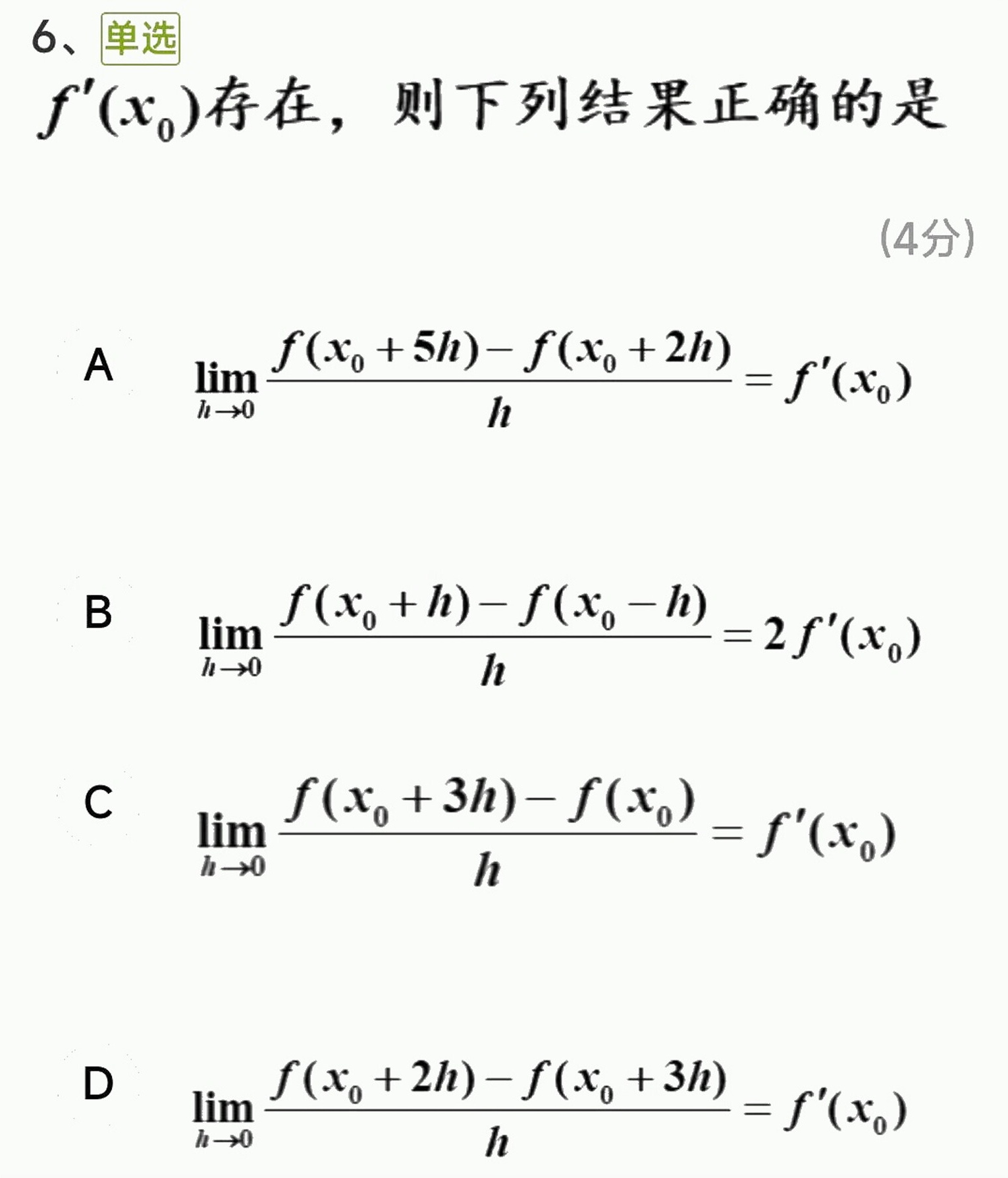
6、单选-|||-f'(x0)存在,则下列结果正确的是-|||-(4分)-|||-A .lim _(harrow 0)dfrac (f({x)_(0)+5h)-f((x)_(0)+2h)}(h)=f'((x)_(0))-|||-B .lim _(harrow 0)dfrac (f({x)_(0)+h)-f((x)_(0)-h)}(h)=2f'((x)_(0)) .-|||-C .lim _(harrow 0)dfrac (f({x)_(0)+3h)-f((x)_(0))}(h)=f'((x)_(0))-|||-D lim _(harrow 0)dfrac (f({x)_(0)+2h)-f((x)_(0)+3h)}(h)=f'((x)_(0))
题目解答
答案
解析
本题主要考察导数的定义及极限运算,需根据根据导数的定义判断各选项极限是否等于$f'(x_0)$。
导数定义:函数$f(x)$在$x_0$处可导,则$f'(x_0)=\lim_{h \to 0}\frac{f(x_0 + h) - f(x_0)}{h}$。
选项分析
选项A
极限为$\lim_{h \to 0}\frac{f(x_0 + 5h) - f(x_0 + 2h)}{h}$,分子可拆分为:
$f(x_0 + 5h) - f(x_0 + 2h) = \left[f(x_0 + 5h) - f(x_0)\right] - \left[f(x_0 + 2h) - f(x_0)\right]$
除以$h$后取极限:
$\lim_{h \to 0}\left[5\cdot\frac{f(x_0 + 5h) - f(x_0)}{5h} - 2\cdot\frac{f(x_0 + 2h) - f(x_0)}{2h}\right] = 5f'(x_0) - 2f'(x_0) = 3f'(x_0) \neq f'(x_0)$
**A错误。
选项B
极限为$\lim_{h \to 0}\frac{f(x_0 + h)ff(x_0 - h)]}{h}$,分子拆分:
$f(x_0 + h) - f(x_0 - h) = \left[f(x_0 + h) - f(x_0)\right] + \left[f(x_0) - f(x_0 - h)\right]$
除以$h$后取极限:
$lim_{h \to 0}\left[\frac{f(x_0 + h) - f(x_0)}{h} + \frac{f(x_0 - h) - f(x_0)}{-h}\right] = f'(x_0) + f'(x_0) = 2f'(x_0) \neq f'(x_0)$
B错误。
选项C
极限为$\lim_{h \to 0}\frac{f(x_0 + 3h) - f(x_0)}{h}$,分子分母同除以$3h$:
$\frac{f(x_0 + 3h) - f(x_0)}{h} = 3\cdot\frac{f(x_0 + 3h) - f(x_0)}{3h}$
取极限得:$3f'(x_0) \neq f'(x_0)$,C错误。
选项D
极限为$\lim_{h \to 0}\frac{f(x_0 + 2h) - f(x_0 +3h)}{h}$,分子变形:
$f(x_0 + 2h) - f(x_0 + 3h) = -\left[f(x_0 + 3h) - f(x_0 + 2h)\right]$
分子分母同除以$h$:
$\frac{f(x_0 + 3h) - f(x_0 + 2h)}{h} = \frac{f((x_0 + 2h) + h) - f(x_0 + 2h)}{h}$
令$\Delta x = h$,当$h \to 0$时$\Delta x \to 0$,极限为:
$lim_{\Delta x \to 0}\frac{f(x_0 + 2 + \Delta x) - f(x_0 + 2h)}{Δx} = f'(x_0 + 2h)$
因$h \to 0$,$x_0 + 2h \to x_0$,故$f'(x_0 + 2h) \to f'(x_0)$,即极限为$f'(x_0)$,D正确。